Foundation settling is one of the most misunderstood home problems in Camarillo. Homeowners often chalk up sloping floors or sticky doors to an aging house or normal wear — and sometimes they are right. But in many cases, those symptoms are early warnings of differential settlement: the uneven sinking of one part of a foundation relative to another. Left unaddressed, differential settlement compounds over time, driving up repair costs and potentially causing significant structural damage.
What Is Differential Settlement and Why Does It Happen Here?
All foundations settle slightly after construction as the soil beneath them compresses under the building's weight. That is normal. The problem begins when different sections of the foundation settle at different rates or to different depths — a condition called differential settlement.
In Camarillo and the broader Ventura County area, several local factors make differential settlement more common than in many other regions:
- Expansive clay soils: Camarillo's native soils contain a high proportion of clay minerals that shrink dramatically during the dry summer months and swell again after winter rains. This repeated movement creates uneven support beneath the foundation.
- Sloped terrain: Hillside neighborhoods like Camarillo Heights and Las Posas Estates are more susceptible to soil creep, where the upper layer of soil slowly migrates downslope over time, pulling away from the uphill side of a foundation.
- Irrigation and drainage: Over-irrigated landscaping and poorly managed downspout discharge concentrate moisture in specific zones beneath the foundation, causing localized soil swelling or washout that produces uneven support.
- Tree root activity: Mature trees in established neighborhoods like Mission Oaks and Old Town Camarillo can draw moisture unevenly from the soil near a foundation, causing differential drying and shrinkage.
- Inadequate original compaction: Homes built on fill soil that was not properly compacted during grading may experience progressive settlement as that fill slowly consolidates under the structure's weight.
How to Recognize Foundation Settling in Your Home
The signs of differential settlement are usually visible throughout the house, not just at the foundation itself. Here is what to look for room by room:
- Floors: A noticeable slope when walking across a room, or a ball rolling consistently toward one wall, suggests the floor framing or slab has shifted. Cracked or popped ceramic tiles on a slab floor are also a telling sign.
- Doors and windows: Frames that are no longer square cause doors to rub at the top or bottom, fail to latch, or swing open or closed on their own. Windows may stick or develop visible gaps in the frame corners.
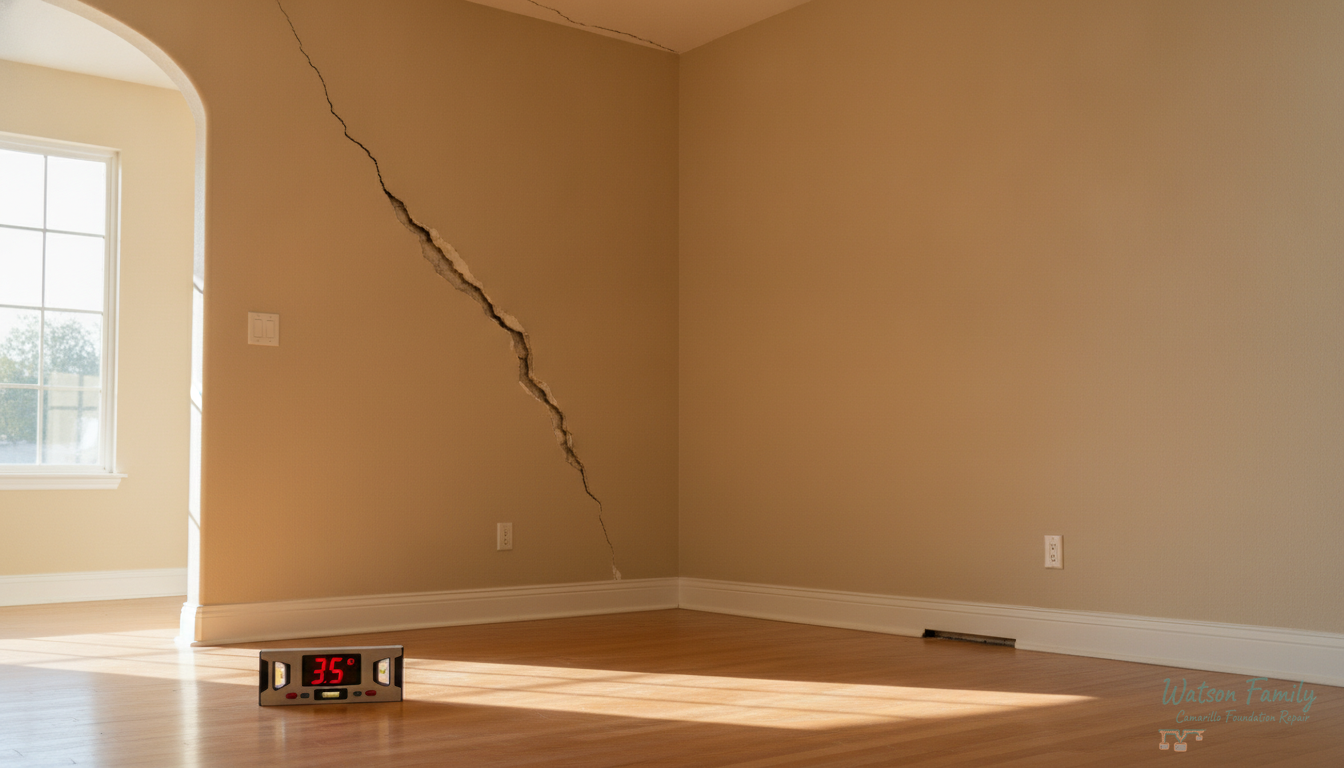
- Walls and ceilings: Diagonal cracks running from door and window corners toward the ceiling are a classic indicator of differential movement in the structure above a settling foundation section. Gaps between interior partition walls and the ceiling may also appear.
- Exterior: Step-cracking along brick or block exteriors, separation between the foundation wall and the house framing, and visible unevenness in the slab edge are all exterior warning signs.
What a Professional Foundation Assessment Reveals
Watson Family Camarillo Foundation Repair begins every settling investigation with a detailed foundation inspection. We use optical levels and digital measuring instruments to map floor elevations across the home, creating a precise picture of how much differential movement has occurred and where it is concentrated. We also evaluate grading, drainage, and any visible crack patterns to identify the probable cause of the settling.
That information drives our repair recommendation. Not every settling case requires the same solution — and we believe homeowners deserve a clear explanation of what is happening before any work begins.
Foundation Leveling Methods We Use in Camarillo
Our foundation leveling and settling correction service offers several proven approaches depending on the type of foundation, the depth of stable soil, and the degree of settlement present.
Concrete and Helical Pier Systems
Pier systems are the most comprehensive solution for significant differential settlement. We excavate alongside the settled footing, attach a steel bracket, and drive piers down through unstable surface soils until they reach stable load-bearing strata. Hydraulic jacks then lift the settled section incrementally toward its original elevation, and the piers are locked in place to provide permanent support.
Helical piers — which are screwed into the ground rather than driven — are particularly effective in Camarillo's clay soils because the helical plates anchor in stable soil below the zone of seasonal moisture fluctuation, providing resistance to both downward settlement and upward heaving.
Mudjacking and Polyurethane Foam Lifting
For concrete slab foundations with smaller voids or more moderate settlement, mudjacking (pressure-injecting a cement slurry beneath the slab) or polyurethane foam injection can restore elevation with minimal excavation. These methods are especially practical for homes in Leisure Village and other communities where minimizing disruption to landscaping and interior finishes is a priority. Learn more about slab-specific repair approaches on our slab foundation repair page.
Addressing Cracks That Accompany Settling
Settlement almost always produces cracking, both in the foundation itself and in the walls and finishes above. Once we have stabilized the foundation through leveling, those existing cracks are addressed as part of the same project. Our foundation crack repair service seals structural fractures with epoxy injection or polyurethane, and in cases where cracks show signs of ongoing lateral pressure, carbon-fiber strap reinforcement prevents future spreading.
After Leveling: Preventing Future Settlement
Stabilizing a settled foundation is an important step, but it is only half of the solution. If the conditions that caused settling — poor drainage, over-irrigation, inadequate grading — are not also corrected, new sections of the foundation may begin to move. We provide guidance after every project on the drainage improvements and maintenance practices that give your repair the best chance of lasting.
For homes with crawl spaces where moisture has been contributing to wood softening and perimeter foundation movement, we often recommend pairing leveling work with our crawl space encapsulation service to eliminate the moisture source entirely.
Schedule Your Foundation Assessment Today
Watson Family Camarillo Foundation Repair serves homeowners throughout Camarillo and surrounding Ventura County communities, including Somis and the rural properties surrounding the city. If your home is showing signs of settling, do not wait for the problem to grow. Call us at (805) 666-6212 or reach us by email at [email protected]. We are open Monday through Sunday, 8:00 AM to 6:00 PM, and we provide written assessment reports so you always know exactly what we found and what we recommend.