When most Camarillo homeowners think about foundation problems, they picture cracks in concrete or a sloping floor. But two other threats deserve equal attention: moisture accumulating in an unprotected crawl space and retaining walls that are no longer doing their job. Both problems are common in the Ventura County region, and both can quietly compromise your home's structural integrity for years before symptoms become obvious.
The Hidden Danger Beneath Your Floor: Crawl Space Moisture
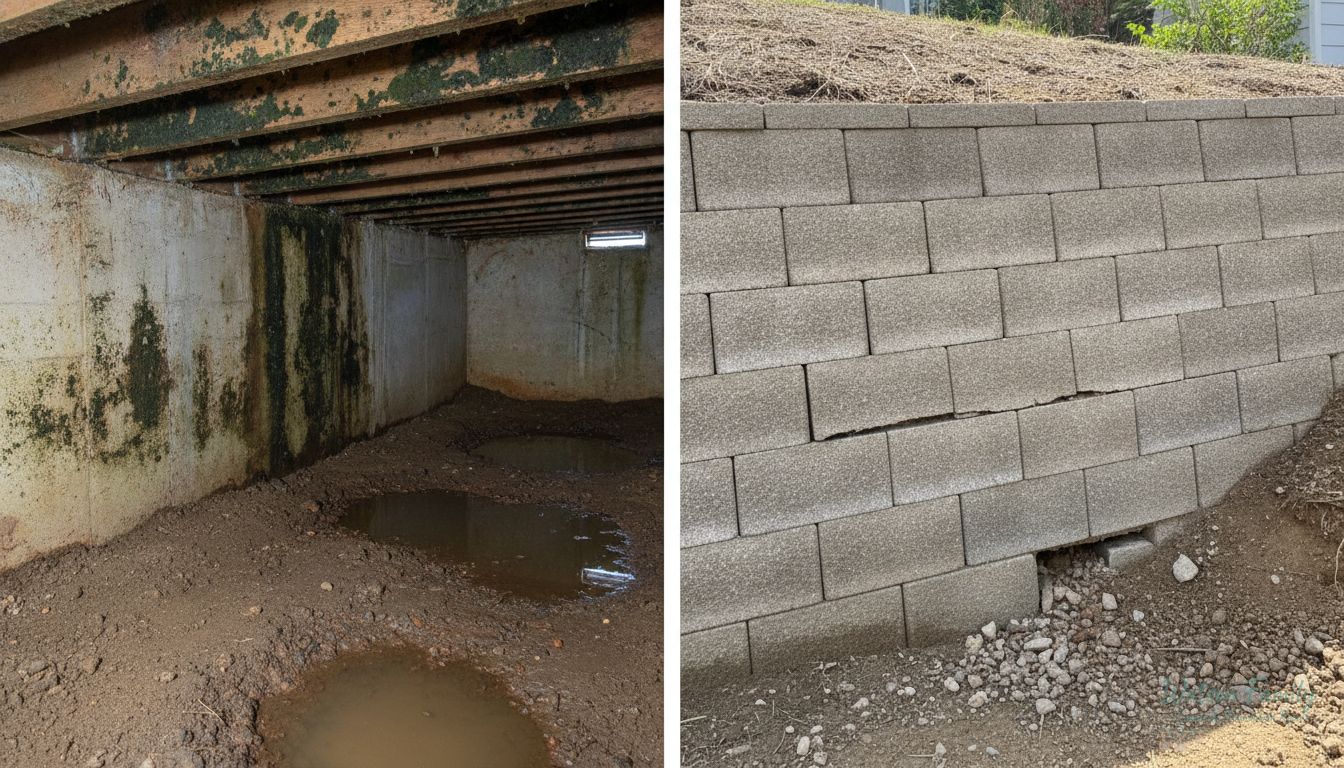
A raised perimeter foundation gives your home a crawl space — the shallow area between the underside of your floor framing and the ground. When that space is left unprotected, it becomes a collection point for ground moisture, condensation, and in some cases standing water. In Camarillo, the combination of marine layer humidity, seasonal rains, and clay soils that hold water near the surface makes crawl space moisture an especially persistent problem.
What Crawl Space Moisture Does to Your Foundation and Framing
The damage from an unencapsulated crawl space unfolds in stages:
- Wood rot: The floor joists, sill plates, and subfloor panels that rest on or near the foundation perimeter absorb moisture over time. As wood softens, it loses load-bearing capacity, and the structure above begins to sag or flex underfoot.
- Mold and mildew: Mold colonies establish quickly in damp crawl spaces and produce spores that migrate upward into the living area, affecting indoor air quality and potentially triggering health issues for occupants.
- Pest entry: Soft, decayed wood is far more attractive to termites and wood-boring beetles than dry, sound lumber. A compromised crawl space is often an entry point for infestations that compound the structural damage.
- Foundation perimeter movement: When sill plates soften and lose their ability to distribute load evenly, the stress transfers directly to the concrete or masonry foundation beneath them. Combined with saturated clay soils pressing against the exterior, this can contribute to perimeter shifting and cracking.
Homeowners in neighborhoods with older housing stock — particularly in Old Town Camarillo — are most likely to have crawl spaces that were built before modern moisture management standards. But even newer homes in communities like Mission Oaks can develop crawl space moisture issues if drainage around the home is not properly maintained.
How Crawl Space Encapsulation Works
Watson Family Camarillo Foundation Repair's crawl space encapsulation service creates a sealed environment that prevents ground moisture from entering the space at all. The process involves:
- Installing a heavy-duty reinforced polyethylene vapor barrier — typically 12 to 20 mil thickness — across the crawl space floor and up the interior faces of the stem walls, sealed at all seams and penetrations
- Adding perforated French drain channels and a sump pump where active water intrusion or standing water is present, so any water that does enter is actively removed before it can accumulate
- Ensuring vents and entry points are appropriately managed to prevent warm, humid outside air from condensing on cooler surfaces inside the crawl space
The result is a dry, stable environment that protects wood framing, discourages pests, and removes one of the primary drivers of foundation perimeter movement. Many homeowners also notice improved energy efficiency and lower utility bills after encapsulation, since conditioned air is no longer escaping through a poorly sealed floor system.
If a foundation inspection reveals that moisture-related wood damage has already affected the perimeter, we discuss the extent of the framing concern and whether any foundation stabilization work — such as foundation leveling — should accompany the encapsulation project.
Retaining Walls: When the Wall Protecting Your Property Becomes the Problem
In Camarillo's hillside neighborhoods — particularly Camarillo Heights, Las Posas Estates, and the rural properties around Somis — retaining walls are essential infrastructure. They hold back soil on sloped lots, prevent erosion, and protect the area around the home's foundation from lateral earth pressure. But retaining walls are under constant stress, and when they begin to fail, the consequences can extend well beyond the wall itself.
Why Retaining Walls Fail
The most common reason a retaining wall fails — regardless of how well it was built — is inadequate drainage. When rain saturates the soil behind a retaining wall, the weight and lateral pressure that the wall must resist increases dramatically. Without proper weep holes, a gravel drainage layer, or a perforated drain pipe behind the wall to relieve that pressure, even solidly constructed concrete or masonry walls will eventually crack, tilt, or overturn.
Other common causes of retaining wall failure include:
- Footing erosion caused by water channeling beneath the base of the wall
- Roots from trees or shrubs growing into and displacing the wall structure
- Overloading from vehicles, heavy equipment, or soil additions placed above the wall beyond its original design capacity
- Age-related deterioration of mortar joints in older concrete masonry unit walls
The Connection Between Retaining Wall Failure and Foundation Damage
When a retaining wall loses its ability to hold back soil, that soil moves — and it often moves toward your home. Increased lateral pressure against a foundation wall can cause bowing, horizontal cracking, and eventually wall failure. Slope instability triggered by a collapsed retaining wall can also undermine the soil beneath footings, leading to rapid and severe differential settlement.
This is why Watson Family Camarillo Foundation Repair treats retaining wall assessment as part of a comprehensive view of your property's structural health. If a retaining wall near your home is leaning, cracking, or showing signs of drainage failure, we evaluate whether the foundation has also been affected and recommend an integrated repair approach. Our foundation inspection service includes assessment of conditions near retaining structures when they are present on the property.
Retaining Wall Repair vs. Replacement
Our retaining wall construction and repair service covers both rehabilitation of existing walls and construction of new walls where existing structures are beyond economical repair. The decision between repair and replacement depends on:
- The degree of tilt or displacement — walls leaning more than approximately one inch per four feet of height typically cannot be safely restored without reconstruction
- The condition of the footing — if footing erosion or displacement is present, patch repairs to the wall face alone will not restore structural integrity
- The extent of drainage failure — walls that failed primarily due to hydrostatic pressure can sometimes be rehabilitated with drainage corrections and crack repair if the structure is otherwise sound
Every new retaining wall we build includes properly sized weep holes, a compacted gravel backfill layer, and perforated drain pipe to manage hydrostatic pressure for the long term — the elements most commonly missing from walls that eventually fail. If soil movement has caused foundation settling on your property alongside retaining wall distress, our foundation leveling service can address the structural effects as part of the same project scope.
A Whole-Property Approach to Foundation Protection
Foundation health is not just about the concrete you can see. The moisture beneath your floors, the walls holding your hillside in place, and the drainage patterns around your entire property all play a role in how well your foundation performs over time. Watson Family Camarillo Foundation Repair takes a comprehensive view of every property we evaluate, connecting the dots between conditions that other contractors might assess in isolation.
Whether you are in Leisure Village and concerned about crawl space moisture, or in Camarillo Heights watching a retaining wall slowly lean away from the hillside, we have the experience and the repair solutions to protect your home. Call Watson Family Camarillo Foundation Repair at (805) 666-6212 or email [email protected] to schedule an inspection. We serve Camarillo and surrounding Ventura County communities seven days a week, 8:00 AM to 6:00 PM.